
There is scepticism in some quarters that the Budget for 2010-11, while spreading cheer, may be skating on thin ice. For instance, some of its assumptions will give way if the non-tax revenue projections turn out to be castles in the air.
'We now look at divestment as an opportunity for maximising the value of public assets, not necessarily as a short-term resource-raising measure.'

An aggressive disinvestment agenda and the auction of spectrum for third-generation mobile telephony allowed the government to project non-tax revenue of Rs 148,118 crore (Rs 1481.18 billion) in 2010-11, an increase of Rs 35, 927 crore (Rs 359.27 billion) or over 30 per cent from the revised estimate of Rs 112,191 crore (Rs 1121.91 billion) in 2009-10.

The collection from borrowings and other liabilities will be 20 paise, while income tax will yield 17 paise to every rupee collection.

People like Manmohan Singh and P Chidambaram, who as finance minister had fully supported the NPS, refuse to exercise their moral and political influence to try and stop Ashok Gehlot and others hell-bent on wrecking the states' finances, notes Virendra Kapoor.


The Union government's fiscal deficit works out to be Rs 5.47 lakh crore or 36.3 per cent of the budget estimates at the end of October 2021 on the back of improvement in revenue collection, according to the data released by the Controller General of Accounts (CGA) on Tuesday. The deficit figures in the current fiscal appear better than the previous financial year when the gap between expenditure and revenue had soared to 119.7 per cent of the last year's Budget Estimates (BE) mainly on account of a jump in expenditure to deal with the COVID-19 pandemic. In absolute terms, the fiscal deficit was Rs 5,47,026 crore at the end of October, the CGA said.

Corporation tax is the single largest source of income, contributing 21 paise to each rupee earned.

Non-Plan expenditure for April-May stood at Rs 2.01 lakh crore.

The divestment target remaining unchanged, from the 2019-20 interim Budget, this year means the Centre will now have to depend on non-tax revenue sources like dividends from the RBI, PSBs and PSUs, as there are real concerns of a tax revenue shortfall. The fiscal deficit target of 3.4% of GDP for 2019-20 is likely to be retained as well.

The economy could grow at 6-6.5 per cent this fiscal year (2019-20 or FY20), said Chief Economic Advisor Krishnamurthy Subramanian, revising his earlier estimate of 7 per cent in the Economic Survey. In an interaction with Arup Roychoudhury, he said supply-side measures, including corporation tax cuts, will boost consumption and demand, and non-tax revenue may make up for shortfall in tax revenues.

Ahead of the Budget, the government has achieved almost half the divestment target of Rs 65,000 crore. FY23 divestment receipts are unlikely to be anywhere close to the budgeted target.
For every rupee in the government coffer, 70 paise will come from direct and indirect taxes, while the government will spend 23 paise towards the states' share of taxes and duties.

Govt may further hike excise on petrol, diesel before Budget.

'We have essentially tried to set out an agenda for the next five years and it, in essence, represents the political commitment to that agenda.'

'If such a practice were feasible, every state would seek additional funds, posing a significant risk to the overall health of the economy.'

The finance minister has stayed true to her commitment to fiscal consolidation, even though the pace of the decline in the deficit could have been faster, notes A K Bhattacharya.

On indirect tax front, the government will earn 21 paise from excise and customs.

The Union government's fiscal deficit further widened to Rs 9.53 lakh crore, which is nearly 120 per cent of the annual budget estimate, at the end of October of the current financial year, according to official data released on Friday. The deficit widened mainly on account of poor revenue realisation. The lockdown imposed to curb spreading of coronavirus infections had significantly impacted business activities and in turn contributed to sluggish revenue realisation.

The Budget for 2018-19 has at least five takeaways that are yet to receive adequate attention, says A K Bhattacharya.

There are 30 listed PSUs in which the public holding is less than 25%.

If the Centre and states are keen on spending more to meet the COVID-19 challenges in the coming year, they must bear in mind the need to raise more resources through taxes and non-tax revenues, suggests A K Bhattacharya.

FinMin does not expect tax or non-tax revenue to reach anywhere close to the targets set in the interim Budget. Sources say that the challenge before the new government will be either to accept the reduced projection and tailor the Budget accordingly or set a more ambitious target.
The deficit for the first five months of the year stood at 96 per cent of the full-year target of Rs 5.46 lakh crore despite cut in capital expenditure in August.

The immediate revenue loss could worsen the Centre's fiscal deficit, from the budgeted 3.3 per cent of gross domestic product (GDP) to 3.7 per cent of GDP -- a massive 40-basis-point increase. It was stabilised at 3.4 per cent since 2016-17, report Abhishek Waghmare and Dilasha Seth.

Lower revenue collection puts upward pressure on government borrowing, ensuring that it deviates from the glided path of debt reduction

'The road ahead for the government's fiscal management will be full of many new challenges,' warns A K Bhattacharya.
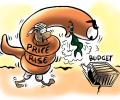
In absolute terms, fiscal deficit went up by 33.6 per cent in April-December 2017 and the revenue deficit by as much as 40.7 per cent compared to the same period the previous year, said Sudipto Mundle.

Do the actual numbers bear out the claims made by the government or do they suggest something else? asks A K Bhattacharya.

Kerala Finance Minister K N Balagopal has sought systemic changes in the GST structure, saying every state and consumer has lost because of its basically flawed architecture that has also led to rampant revenue leakage for the states. The Goods and Services Tax (GST) regime came into force in July 2017. Even though the framework is focused on having a one-nation-one-tax model, quite a few items, including petroleum products and liquor are still out of the GST purview.
Finance Minister Arun Jaitley presented the Budget today.

Finance Minister Ishaq Dar, who presented the budget in the National Assembly, the lower house of parliament, said the government will target a growth rate of 3.5 per cent in the coming fiscal year.
The Centre and states are likely to budget for higher market borrowings to the tune of Rs 2.3 lakh crore next fiscal even though the Union budget may peg a lower-than-expected fiscal deficit for the Centre at 5.8 per cent of GDP, says a report. Icra Ratings anticipates higher redemptions will lead to gross market borrowings of the Centre to rise to Rs 14.8 lakh crore and of the states to jump by Rs 1.6 lakh crore to Rs 9.6 lakh crore, taking the combined borrowings (of the Centre and the states) to Rs 24.4 lakh crore in FY2024, up by 2.3 lakh crore from FY23 combined. In FY23, the Centre's gross borrowings are budgeted at Rs 14.1 lakh crore and of the states at Rs 8 lakh crore, or a combined borrowing of Rs 22.1 lakh crore, according to the agency.
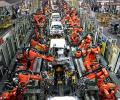
India's economy grew 6.1 per cent in the fourth quarter of 2022-23, pushing up the annual growth rate to 7.2 per cent, official data showed on Wednesday.

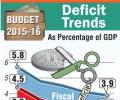
The fiscal deficit for 2015-16 may eventually come down to the targeted level of 3.9 per cent of GDP.
While presenting her 2021-22 Union Budget, Finance Minister Nirmala Sitharaman had set a fiscal deficit target of 6.8 per cent of nominal gross domestic product (GDP) against the 2020-21 Revised Estimate of 9.5 per cent. The fiscal correction in the upcoming 2022-23 Union Budget is unlikely to be that steep. Even as discussions among top Budget-makers are ongoing, the fiscal deficit target for 2022-23 may likely be in the range of 6.5-6.8 per cent.

Instead, 2019-20 could be the base from which the Budget estimates for next year are calculated.

'There is a time for lowering one's expectations of the economy -- and therefore not trying to do too much in the Budget,' notes T N Ninan.

The major beneficiaries have been the ministries of roads and highways, railways and power
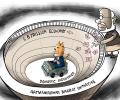
The Indian economy is on the path of a durable recovery on the back of conducive monetary and credit conditions, the global headwinds notwithstanding, said a Reserve Bank of India (RBI) article on the state of the economy. Domestically, there have been several positives on the COVID-19 front, in terms of reduced infections and faster vaccinations, the article published in the RBI Bulletin November 2021 added. The Indian economy, the article said, is clearly differentiating itself from the global situation, which is marred by supply disruptions, stubborn inflation and surges of infections in various parts of the world.
